
Magnus Josefsson has come second in the EDAMBA (European Doctoral Association) thesis competition for his work ‘Social Foundations of Sense Making: Four Case Studies’.
Magnus Josefsson has come second in the EDAMBA (European Doctoral Association) thesis competition, for his thesis…
Social Foundations of Sense Making: Four Case Studies
Awarded in 2015
hn2. Abstract
This thesis addresses the problem of sense making in organisations. It considers how
a particular type of knowledge intensive organisation, a creative / interactive agency,
tries to make sense of itself in the context of a rapidly evolving and transient external
environment, the Internet.
The study portrays how creative / interactive agencies are subject to serendipitous
events in a vastly complex transient ecology. The study presents a qualitative
analysis of four cases that are typical examples of knowledge intensive organisations
in the creative industries in the UK’s North West region. The study finds that this
type of organisation is fundamentally dependent on expert resources, not just as
actual skills, but in the way, those resources represent and connect to social domains
of knowledge and practice. This dependency is the source of continuity but also
unpredictability. These unstable organisations are subject to the eclectic motifs of
employees that have their own agendas. These employees are committed to their
own professional objectives and the organisations are the means to those objectives
and not to a long-term career.
The study makes several important contributions to knowledge.
- Firstly, how an environment influences and affects an organisation will depend on
the organisation itself as a composition of attentions and interests. - Secondly, heterogeneous resources individually create meaningful environments
when they focus their attentions on elements of experience relevant to their interests.
The sense-making problem is bringing those idiosyncratic interests to some
collectively meaningful interpretation and a functional coalition whilst preserving
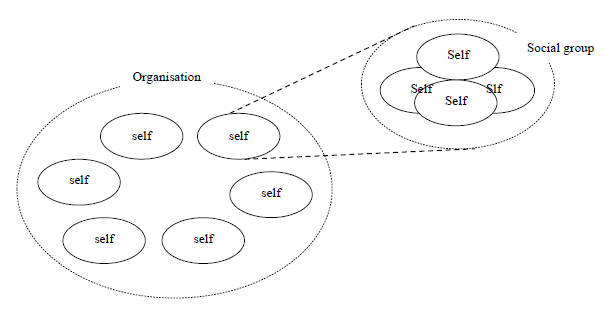
the creative incentive that is the key value generator in this type of enterprise. - Thirdly, findings emphasise how those resources belong to different social domains
that in complex ways influence their interpretation of the environment and perceived
action possibilities. These social domains are meritocracies by which social actors
measure themselves and their peers against socially ordained criteria of what is
creatively and professionally acceptable. These same criteria also determine the
reputation and hence the ability of organisations to attract and retain these individuals. The study contains an example of a case that fails in this respect and consequently faces dissolution and bankruptcy. Because of these complex network effects, it becomes difficult to determine the actual span of the organisational system and even harder to define its span of control.
The study also illustrates how decision makers make boundedly rational assessments of situations. Those assessments guide strategic decisions, but they do not mean decision makers understand a situation. They have more do with decision makers making sense by drawing on the most salient feature of their experience. In a way, decision makers make sense of themselves and not the situation.
This thesis questions the assumption that the leader is the key architect of meaning and purposeful action. Rather, in this type of enterprise, it is more appropriate to conceive the leader’s role as orchestrating expertise and relationships. The leader’s most important role may be to initiate and sustain action as a prerequisite to progress and the creation of value rather than micro managing the production process directly. The organisation is itself a self-reflexive social system of heterogeneous social actors that in action and interaction are continuously creating and modifying the ecology.
The thesis identifies the traits and properties of those social actors and considers what factors drive interaction between them and how those affect the organisations for which they work. It introduces the systems concept of requisite variety as an important construct in the study of sense making in organisations
The study concludes by outlining theoretical and practical contribution and makes propositions for further research.